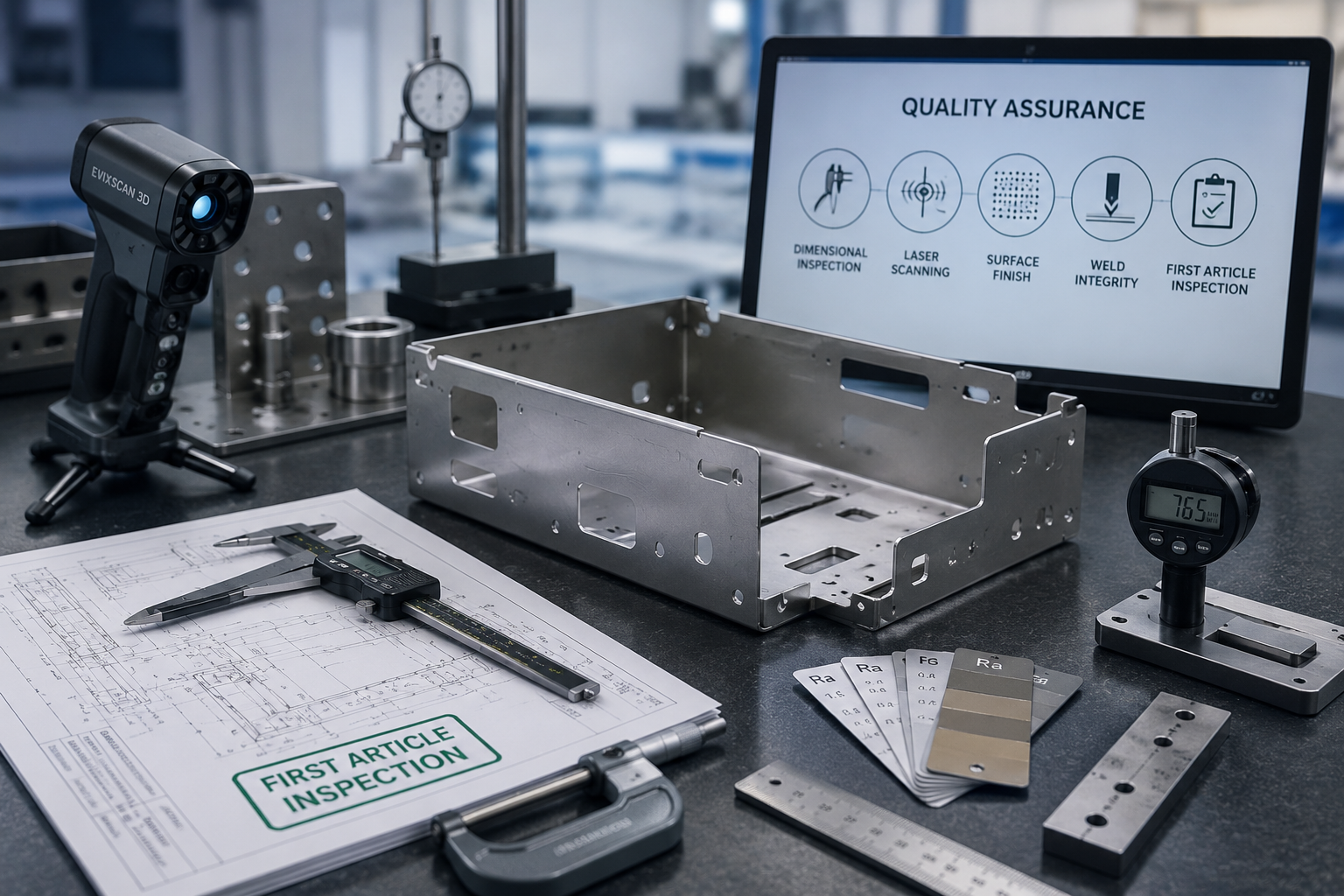
5 Inspection And Verification Methods In Precision Sheet Metal Fabrication
Inspection plays a key role in modern manufacturing, but it is often misunderstood. Many buyers know quality checks take place during fabrication, yet few understand how components are actually measured, verified and approved before reaching assembly or end use.
In reality, there is no single inspection process that confirms quality. Different verification methods are used to identify different manufacturing risks. Some inspections focus on dimensional accuracy, others assess surface quality, weld integrity or production consistency.
At Greengate Metal Components, inspection supports manufacturing consistency by providing objective verification throughout production. However, inspection alone does not create quality. Its role is to confirm that manufacturing processes are producing components that meet specification requirements.
Understanding how different inspection methods work can help engineers, procurement teams and manufacturing businesses make more informed decisions when evaluating suppliers and quality assurance processes.
Dimensional Inspection Using Coordinate Measuring Equipment
Dimensional inspection verifies that fabricated parts match specified measurements and tolerances before moving to the next production stage.
Many fabrication issues are not immediately visible. A component may appear correct when viewed in isolation, yet dimensional variation can create significant assembly problems later in production.
This is why dimensional inspection focuses on critical measurements such as:
Hole locations
Feature positions
Overall dimensions
Bend locations
Formed features
Assembly interfaces
A typical dimensional verification process may involve:
Identifying critical dimensions from engineering drawings
Measuring key features against specification requirements
Verifying tolerance compliance
Recording inspection results
Approving the component for the next production stage
Consider an enclosure panel with multiple mounting holes. If a single hole position drifts outside specification, the panel itself may appear acceptable. However, assembly teams may later discover that fasteners no longer align correctly.
This is why dimensional inspection is ultimately about functionality rather than measurement alone.
Understanding the factors that influencefeature accuracy helps explain why dimensional verification remains one of the most important quality assurance activities in sheet metal fabrication.
At Greengate, dimensional verification is viewed as part of a wider process control strategy because identifying dimensional variation early helps prevent more costly downstream issues.
Laser Scanning And Optical Measurement Techniques
Laser scanning and optical inspection can rapidly verify complex geometries without physically contacting the component.
Traditional measurement tools are highly effective for many applications. However, they become less practical when inspecting large assemblies, complex formed geometries or components with multiple interacting dimensions.
In these situations, non-contact inspection methods can provide additional advantages.
Traditional Measurement
Optical And Laser Measurement
Physical contact required
Non-contact verification
Suitable for individual features
Suitable for complete geometries
Ideal for simple dimensions
Useful for complex shapes
Feature-by-feature measurement
Digital comparison across larger areas
One common application involves comparing a fabricated component against CAD data to identify dimensional variation across the entire part.
For example, a large enclosure assembly may contain multiple formed sections, cut-outs and mounting features. Measuring every feature individually can be time-consuming. Laser scanning allows inspectors to compare the finished geometry against the original design more efficiently.
These technologies are particularly valuable where traditional measurement becomes difficult due to component size, complexity or accessibility.
As manufacturing technologies continue to evolve, advanced inspection methods increasingly support quality verification alongside processes such aslaser cutting services.
The goal is not to replace conventional measurement but to provide additional visibility into manufacturing performance where appropriate.
Surface Finish And Coating Thickness Testing
Surface quality inspection helps ensure components meet both functional and appearance requirements.
Surface inspection is often associated with aesthetics, but its importance extends far beyond visual appearance.
Surface quality can influence:
Coating performance
Corrosion resistance
Assembly fit
Product durability
Safe handling characteristics
Customer perception
A typical surface quality inspection checklist may include:
Surface defects
Scratches and handling damage
Burr formation
Edge condition
Coating consistency
Coating thickness verification
For example, a powder-coated enclosure may appear visually acceptable while still containing coating thickness variation that could affect long-term durability or performance expectations.
Similarly, burrs or surface contamination introduced during fabrication can influence coating adhesion and create problems that only become visible later in service.
Inspection afterpowder coating helps verify that finishing processes have achieved the intended outcome while also identifying any issues that may have originated earlier in production.
At Greengate, surface quality is considered in the context of how a component will be used because appearance, durability and functionality are often closely linked.
Non-Destructive Testing For Weld Integrity
Non-destructive testing allows weld quality to be assessed without damaging the finished component.
Weld inspection is not simply about finding defects. Its purpose is to verify that a welded joint can perform as intended under the conditions it was designed for.
Different inspection methods are used depending on application requirements, component complexity and quality expectations.
Inspection Method
Typical Purpose
Visual inspection
Identify obvious surface defects
Dye penetrant testing
Detect surface-breaking discontinuities
Magnetic particle testing
Identify defects in suitable ferromagnetic materials
Ultrasonic testing
Assess internal weld characteristics where appropriate
Visual inspection is often the starting point because many common weld issues can be identified through careful examination.
However, some defects may not be immediately visible.
For example, dye penetrant testing can help reveal surface-breaking flaws that might otherwise remain undetected during visual inspection alone.
More advanced techniques may be used where additional verification is required.
The level of inspection should always reflect the application and associated risks. Not every fabrication project requires advanced testing, but understanding when additional verification may be beneficial is an important part of manufacturing quality planning.
This is one reason why experiencedwelding services providers consider inspection requirements alongside fabrication requirements rather than treating them as separate activities.
At Greengate, weld verification is viewed as part of the broader manufacturing process because weld quality influences assembly performance, durability and overall project outcomes.
First Article Inspection And Batch Verification Processes
First article inspection verifies that initial production parts meet specification before full-scale manufacturing begins.
Few quality assurance activities provide greater value than identifying a problem before it affects an entire production batch.
A dimensional issue on one component is usually manageable.
The same issue repeated across hundreds of components can create significant production disruption, rework and cost.
A typical first article and batch verification process may include:
Manufacturing the initial component
Verifying dimensions and critical features
Reviewing compliance against drawings and specifications
Approving the first article
Releasing production
Performing ongoing batch verification throughout manufacture
This approach helps confirm that production processes are operating as intended before larger quantities are manufactured.
Importantly, verification does not stop after the first article is approved.
Ongoing inspection remains necessary because manufacturing consistency depends on maintaining process control throughout the production run.
At Greengate, quality assurance focuses on repeatability as much as accuracy. Producing one compliant component is important. Producing the same result consistently throughout production is what ultimately supports reliable manufacturing outcomes.
This principle closely aligns with the value ofearly engineering input, where potential manufacturing challenges can often be identified before they develop into larger production issues.
Inspection Verifies Quality, It Does Not Create It
Different sheet metal fabrication inspection methods exist because different manufacturing risks require different forms of verification.
Dimensional inspection helps prevent assembly problems. Optical measurement supports the assessment of complex geometries. Surface inspection verifies finishing quality. Weld testing helps confirm structural integrity. First article inspection supports production consistency before manufacturing scales.
Together, these processes help manufacturers identify variation, validate compliance and maintain confidence throughout production.
However, inspection should always be viewed as part of a wider quality assurance system. The strongest manufacturing outcomes come from combining effective process control with appropriate verification at every stage of production.
At Greengate Metal Components, inspection activities are integrated throughout the manufacturing process to support consistency, repeatability and customer confidence. The objective is not simply to identify defects, but to help ensure components continue to meet requirements as production progresses.
If you’re reviewing fabrication requirements and want to understand how quality can be verified throughout production,contact us to discuss your project.
Why 316L Stainless Steel Is Specified for Aggressive Food Processing Environments
Selecting the correct stainless steel grade for food processing equipment influences hygiene, corrosion resistance and long-term performance. Where equipment operates...
15 Sep 2026
CZ108 vs CZ121 Brass: Which Grade Suits Your Component?
Selecting the right brass grade involves more than comparing strength or material cost. When assessing CZ108 vs CZ121, the key...
01 Sep 2026
How Carbon Content Affects the Weldability and Formability of Mild Steel
Carbon content affects more than the mechanical properties of mild steel. It also influences how the material performs during welding,...
Manage Consent
To provide the best experiences, we use technologies like cookies to store and/or access device information. Consenting to these technologies will allow us to process data such as browsing behaviour or unique IDs on this site. Not consenting or withdrawing consent, may adversely affect certain features and functions.
Functional
Always active
The technical storage or access is strictly necessary for the legitimate purpose of enabling the use of a specific service explicitly requested by the subscriber or user, or for the sole purpose of carrying out the transmission of a communication over an electronic communications network.
Preferences
The technical storage or access is necessary for the legitimate purpose of storing preferences that are not requested by the subscriber or user.
Statistics
The technical storage or access that is used exclusively for statistical purposes.The technical storage or access that is used exclusively for anonymous statistical purposes. Without a subpoena, voluntary compliance on the part of your Internet Service Provider, or additional records from a third party, information stored or retrieved for this purpose alone cannot usually be used to identify you.
Marketing
The technical storage or access is required to create user profiles to send advertising, or to track the user on a website or across several websites for similar marketing purposes.