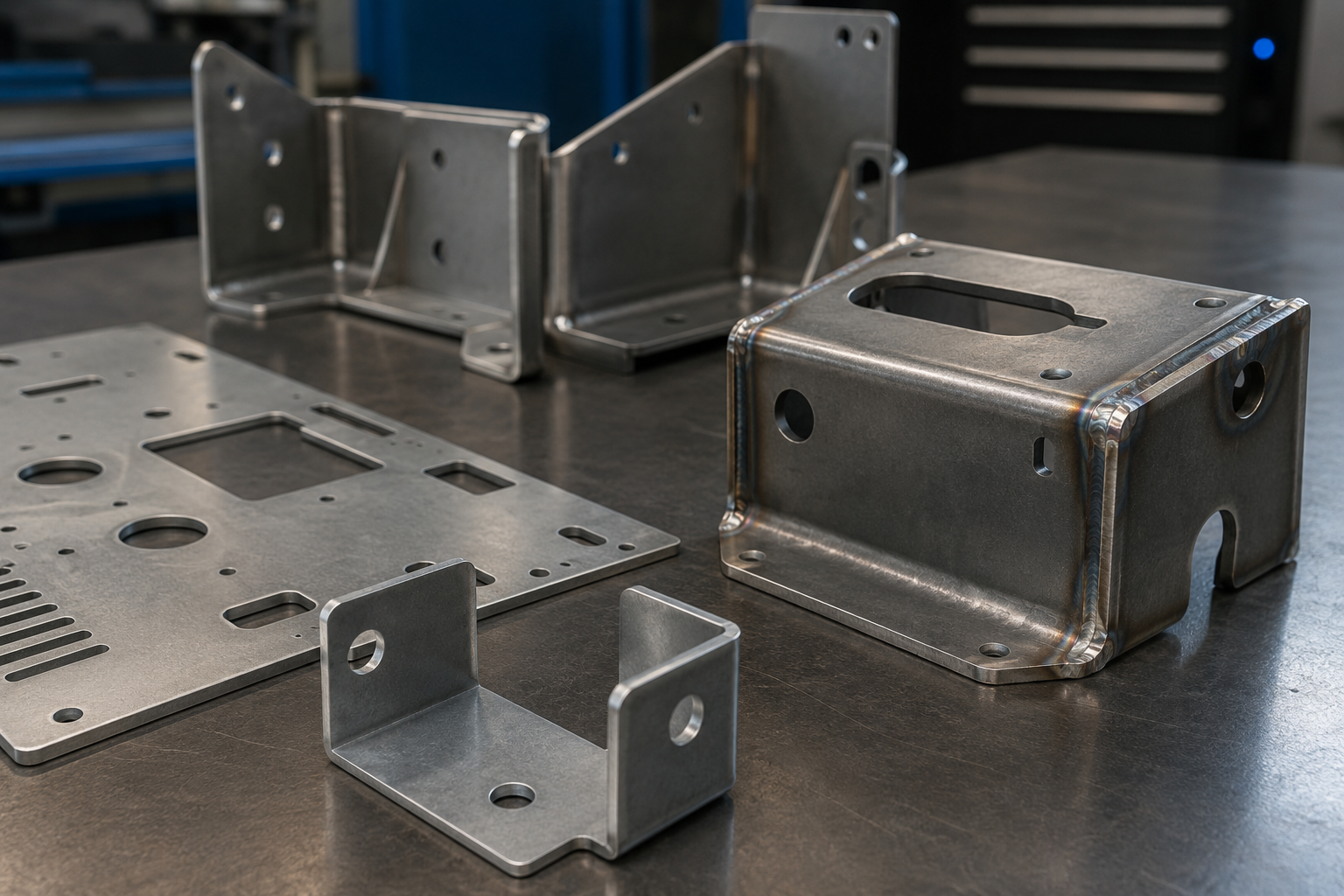
What Is The Impact Of Laser Cutting, Bending And Welding Alignment On Final Accuracy?
Dimensional accuracy is one of the most important considerations in sheet metal fabrication. Yet many manufacturing challenges arise not because a single process has failed, but because small variations accumulate throughout production.
A common assumption is that if laser cutting is accurate, bending is controlled, and welding is completed correctly, the final component will automatically meet specification. In reality, fabrication accuracy is influenced by how these processes interact with one another.
A component may pass inspection at each manufacturing stage and still create assembly issues if cumulative alignment is not properly managed. Small deviations in geometry, positioning, forming and welding can combine to affect fit, functionality and overall performance.
At Greengate Metal Components, dimensional accuracy is viewed as a manufacturing system rather than the result of any individual process. Process planning, inspection and production control all contribute to maintaining alignment throughout fabrication.
Understanding how laser cutting, bending and welding influence one another helps explain why final component accuracy depends on more than the precision of any single operation.
How Laser Cutting Accuracy Influences Component Geometry
Laser cutting creates the foundation for dimensional accuracy because every subsequent manufacturing process relies on the geometry established during cutting.
The cut profile defines the starting point for all future operations. Hole positions, slot locations, edge relationships and feature spacing are established before bending, welding or assembly begins.
This means that even small variations introduced during cutting can influence later stages of production.
Consider a mounting panel with multiple fixing holes.
If a hole position is slightly offset during cutting, the issue may not immediately create a problem. However, once the panel is bent, assembled and installed, that variation may affect fastener alignment, mating components or installation accuracy.
For example, a hole position that is only slightly out of location may still allow a component to pass initial inspection. Once bends are introduced and mating parts are assembled, the positional error may prevent fasteners from aligning correctly. What began as a minor cutting variation can eventually become an assembly problem several operations later.
This is one reason why manufacturers often focus on critical feature relationships rather than individual dimensions in isolation. The question is not simply whether a hole is correctly positioned, but whether that hole will continue to function as intended throughout the rest of the manufacturing process.
This is why fabrication accuracy should be viewed as a chain of dependent processes rather than a series of isolated operations.
Key factors influenced by cutting geometry include:
Feature positioning
Hole locations
Profile accuracy
Edge condition
Assembly references
Bend datum locations
Accurate cutting reduces the need for downstream correction and helps maintain consistency throughout production.
Modernlaser cutting services provide the starting point for dimensional control, but the final result still depends on how subsequent manufacturing stages are managed.
The Effect Of Bending Alignment On Dimensional Consistency
Even accurately cut components can lose dimensional consistency if bending alignment is not properly controlled.
Bending transforms a flat component into a three-dimensional part. During this process, material behaviour begins to play a significant role in final geometry.
Factors such as bend positioning, tooling selection, bend sequence and material springback all influence dimensional outcomes.
Consider a simple fabricated bracket.
The flat profile may be dimensionally correct before forming. However, if bend positioning varies or springback is not adequately accounted for, the final leg lengths, hole relationships and assembly dimensions may no longer align with design intent.
Bending also changes how dimensions are referenced. A measurement that is straightforward on a flat component may become significantly more difficult to control once multiple bends have been introduced.
For example, two holes may be positioned correctly on a flat blank. After forming, however, the relationship between those holes and a mating component may change if bend angles vary slightly. The individual features remain accurate, but the assembled geometry may not.
This distinction is important because customers rarely purchase flat blanks. They purchase finished components that must fit correctly within a larger assembly.
This is particularly important where multiple bends interact.
For example:
Bend one establishes the first reference plane.
Bend two relies on the position of bend one.
Bend three relies on the position of both previous bends.
A small variation early in the process can influence multiple downstream dimensions.
This is why dimensional consistency often depends as much on process control as it does on machine capability.
Effectivemetal bending and forming requires consideration of how each forming operation affects the final geometry rather than focusing solely on individual bend dimensions.
At Greengate, forming processes are evaluated in relation to the finished component because assembly performance is ultimately more important than any single measurement.
Welding Distortion And Its Impact On Assembly Fit
Heat introduced during welding can cause movement, distortion and dimensional changes that affect final assembly performance.
Unlike cutting and bending, welding introduces thermal energy into the component. As material heats and cools, expansion and contraction occur.
These changes can alter component geometry even when all preceding manufacturing stages were completed correctly.
Common effects include:
Distortion
Shrinkage
Angular movement
Joint displacement
Loss of squareness
Positional variation
Consider a fabricated frame that is perfectly aligned prior to welding.
Once welds are introduced, thermal movement may pull sections out of position, creating dimensional variation that affects installation or assembly.
Consider a rectangular frame designed to support doors, panels or mounted equipment. Even a relatively small amount of distortion can affect squareness across the assembly. The structure may remain mechanically sound, yet components designed to fit within it may no longer align correctly.
In these situations, the challenge is rarely the weld itself. The challenge is managing how thermal movement influences the surrounding geometry.
A simplified cause-and-effect example illustrates the issue:
At Greengate, welding is considered within the context of the complete assembly because dimensional accuracy must be maintained throughout the manufacturing process, not just before welding begins.
Cumulative Tolerance Build Up Across Multiple Processes
Small dimensional variations can accumulate across cutting, bending and welding processes to create larger deviations in the finished component.
This concept is often referred to as tolerance stack-up.
It is one of the most important principles in fabrication accuracy because individual processes can remain within specification while the finished assembly still experiences alignment issues.
A simplified example illustrates how this occurs:
Manufacturing Stage
Small Variation
Laser cutting
Minor positional variation
Bending
Minor angular variation
Welding
Minor alignment movement
Final assembly
Noticeable fit issue
None of the individual processes have necessarily failed.
However, the cumulative effect of several small variations can influence the final outcome.
Tolerance stack-up is often misunderstood because each manufacturing stage can technically meet its own requirements.
Consider a component where cutting introduces a small positional variation, bending introduces a small angular variation, and welding creates a small amount of movement. Individually, each result may remain within specification. Collectively, however, those variations can combine and influence the final assembly.
This explains why dimensional accuracy cannot be assessed solely by reviewing individual manufacturing stages.
Experienced manufacturers, therefore, assess dimensional requirements at assembly level rather than process level. The objective is not simply to control individual operations. It is to ensure the finished product continues to meet functional requirements after every manufacturing stage has been completed.
Instead, manufacturers must consider:
Feature relationships
Assembly requirements
Datum references
Process interactions
Functional performance
Understanding the factors that influencefeature accuracy provides useful context for understanding how dimensional variation can accumulate throughout production.
At Greengate, dimensional verification focuses on how components function within the wider assembly rather than evaluating measurements in isolation.
Alignment Errors And Their Effect On Functional Performance
Alignment issues can affect far more than appearance, often influencing fit, movement, strength and functionality.
A component may look acceptable while still creating operational problems once installed.
Potential consequences include:
Poor assembly fit
Misaligned fixings
Increased installation time
Reduced mechanical performance
Uneven load distribution
Operational reliability concerns
Consider an enclosure assembly.
If several panels experience minor alignment variation, the resulting issue may not become apparent until final assembly, when doors, hinges or mating components no longer align correctly.
This can create knock-on effects throughout installation. Engineers may need to modify components, adjust fixing positions or compensate for variation elsewhere in the assembly. These corrective actions increase labour requirements and can introduce additional quality risks.
This is particularly relevant in applications involvingmetal cabinets and enclosures, where dimensional relationships often influence both appearance and functionality.
For engineering teams, dimensional accuracy is rarely an objective in itself.
Its purpose is to ensure components fit, perform and operate as intended.
The Relationship Between Process Sequencing And Final Accuracy
The order in which fabrication processes are performed can significantly influence final dimensional accuracy.
Process sequencing is often overlooked, yet it plays an important role in controlling variation.
Manufacturing decisions made early in production can affect every subsequent operation.
Process sequencing is often a balance between manufacturing efficiency and dimensional control.
For example, welding a component before forming may simplify production in some situations. In others, it may introduce distortion that becomes more difficult to manage during subsequent operations.
Similarly, inspection points placed too late in the manufacturing process can allow variation to pass through multiple stages before being identified.
The most effective manufacturing workflows are therefore designed not only around production efficiency, but around controlling risk as fabrication progresses.
Consider the following example:
Approach
Potential Outcome
Forming before welding
Reduced distortion impact on formed features
Welding before forming
Different distortion behaviour and alignment considerations
Inspection only at the final stage
Issues identified later
Inspection at key stages
Earlier identification of variation
The most appropriate sequence depends on component design, manufacturing requirements and assembly objectives.
This is why fabrication planning should be considered as part of dimensional control rather than a separate activity.
At Greengate, manufacturing reviews often focus on how processes interact rather than evaluating cutting, bending and welding independently.
This approach aligns closely with the value ofearly engineering input, where potential accuracy challenges can be identified before production begins.
How Fixturing And Tooling Influence Alignment Precision
Fixtures and tooling help maintain repeatable positioning throughout production and reduce variation between components.
Even highly capable manufacturing equipment relies on accurate positioning.
Fixturing provides controlled references that help maintain alignment during fabrication and assembly.
Key functions include:
Workholding
Component positioning
Alignment control
Repeatability support
Production consistency
Modern fabrication equipment is capable of producing highly consistent results, but those results depend on the component being presented to the process in a repeatable position.
A welding fixture, for example, does not improve weld quality directly. Instead, it helps ensure components begin each operation from the same location and orientation.
This distinction is important because repeatability is often the foundation of dimensional consistency across larger production runs.
Consider a welded assembly produced without consistent fixturing.
Each component may be positioned slightly differently before welding begins.
Those differences may be small, but they can create noticeable variation across an entire production batch.
By comparison, fixture-assisted production helps establish repeatable positioning before fabrication processes are performed.
This is particularly important within integrated manufacturing environments where fabrication progresses intosheet metal assembly and final product integration.
At Greengate, fixturing is viewed as a process-control tool because consistency depends on maintaining repeatable positioning throughout production.
Methods To Control Alignment And Improve Overall Accuracy
Manufacturers improve accuracy by combining process planning, inspection, fixturing and controlled production methods.
No single process guarantees dimensional accuracy.
Instead, successful fabrication depends on managing how cutting, bending, welding and assembly interact throughout production.
A practical approach to alignment control typically includes:
Early design review
Process planning
Appropriate fixturing
Controlled manufacturing sequences
In-process inspection
Final verification
Continuous process improvement
Importantly, these activities should work together.
Inspection can identify variation, but it cannot eliminate the root causes of dimensional issues. Likewise, accurate cutting alone cannot compensate for uncontrolled bending or welding distortion later in production.
This is why effective manufacturing systems focus on prevention as well as verification.
At Greengate, dimensional accuracy is treated as a cumulative outcome influenced by every stage of production. The objective is not simply to produce accurate individual parts, but to ensure those parts continue to fit, align and perform correctly as fabrication progresses.
As explored in our guide towhat defines quality in modern sheet metal fabrication, process control, repeatability and manufacturing planning are often just as important as individual measurements.
Accuracy Is Created By Process Interaction, Not Individual Processes
Laser cutting, bending and welding all influence final component accuracy, but none of these processes operate in isolation.
A component can pass inspection at every manufacturing stage and still experience assembly issues if cumulative variation is not properly managed. Small deviations in geometry, alignment and positioning can combine throughout production to affect fit, functionality and performance.
This is why dimensional accuracy should be viewed as a manufacturing system rather than a collection of individual processes.
The most effective fabrication strategies focus on controlling how processes interact, managing variation before it accumulates and ensuring assemblies continue to perform as intended throughout production.
At Greengate Metal Components, dimensional accuracy is considered at the assembly level rather than the process level. The objective is not simply to produce accurate individual components, but to ensure those components continue to fit and perform correctly as fabrication progresses through cutting, forming, welding and assembly.
If you’re developing a fabricated component where dimensional accuracy and assembly performance are critical,contact us to discuss your manufacturing requirements.
Why 316L Stainless Steel Is Specified for Aggressive Food Processing Environments
Selecting the correct stainless steel grade for food processing equipment influences hygiene, corrosion resistance and long-term performance. Where equipment operates...
15 Sep 2026
CZ108 vs CZ121 Brass: Which Grade Suits Your Component?
Selecting the right brass grade involves more than comparing strength or material cost. When assessing CZ108 vs CZ121, the key...
01 Sep 2026
How Carbon Content Affects the Weldability and Formability of Mild Steel
Carbon content affects more than the mechanical properties of mild steel. It also influences how the material performs during welding,...
Manage Consent
To provide the best experiences, we use technologies like cookies to store and/or access device information. Consenting to these technologies will allow us to process data such as browsing behaviour or unique IDs on this site. Not consenting or withdrawing consent, may adversely affect certain features and functions.
Functional
Always active
The technical storage or access is strictly necessary for the legitimate purpose of enabling the use of a specific service explicitly requested by the subscriber or user, or for the sole purpose of carrying out the transmission of a communication over an electronic communications network.
Preferences
The technical storage or access is necessary for the legitimate purpose of storing preferences that are not requested by the subscriber or user.
Statistics
The technical storage or access that is used exclusively for statistical purposes.The technical storage or access that is used exclusively for anonymous statistical purposes. Without a subpoena, voluntary compliance on the part of your Internet Service Provider, or additional records from a third party, information stored or retrieved for this purpose alone cannot usually be used to identify you.
Marketing
The technical storage or access is required to create user profiles to send advertising, or to track the user on a website or across several websites for similar marketing purposes.