Choosing a MIG welding supplier isn’t simply about finding a company that can join metal together. The supplier you select will influence manufacturing quality, production efficiency, delivery reliability and, ultimately, the performance of the finished product.
For procurement teams, manufacturing engineers and design engineers, the challenge is rarely a lack of choice. Many suppliers offer similar services, comparable equipment and competitive quotations. The real difference lies in how they approach manufacturing, solve production challenges and maintain consistency once a project moves beyond the prototype stage.
Manufacturers looking to outsource welded assemblies often benefit from choosing a supplier with comprehensive metal welding capabilities that integrate seamlessly with fabrication, forming and finishing processes.
At Greengate Metal Components, welding forms part of a broader fabrication process that includes laser cutting, CNC punching, bending, machining, finishing and assembly. Looking at projects from this wider manufacturing perspective helps identify potential issues before production begins, supporting better outcomes for customers and reducing avoidable manufacturing risks.
Whether you’re sourcing a new supplier, reviewing your current supply chain or preparing a new product for manufacture, the questions you ask before placing an order can have a significant impact on the success of your project.
Assess Their MIG Welding Capability, Not Just Their Equipment
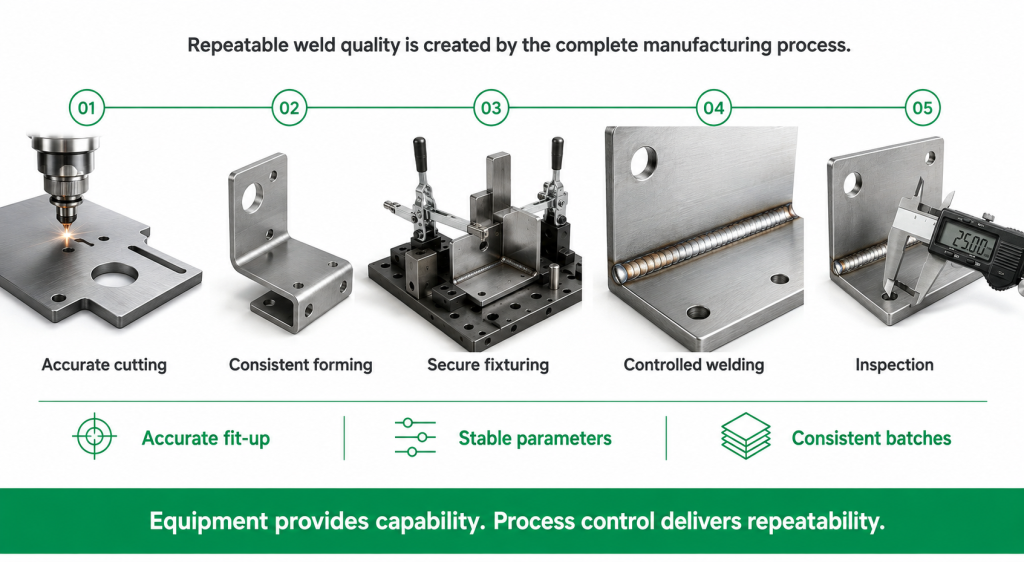
The strongest MIG welding suppliers combine suitable equipment with experienced people, controlled manufacturing processes and a clear understanding of fabricated assemblies.
One of the most common misconceptions is that newer welding equipment automatically produces better results. While reliable machinery is undoubtedly important, the equipment itself is rarely what separates an average supplier from an excellent one.
The quality of a welded component is influenced long before the first arc is struck.
Component accuracy, material preparation, joint design, fixturing, weld sequencing and inspection all play a role in determining whether the finished assembly consistently meets specification. Even two suppliers using the same welding equipment can produce very different outcomes depending on how well those surrounding processes are managed.
When evaluating a supplier, look beyond the machinery and consider the wider manufacturing capability.
Ask whether they can support:
- Prototype development as well as repeat production
- Simple fabrications and complex welded assemblies
- Different material types and thicknesses
- Multiple fabrication processes within the same project
- Consistent manufacturing across repeat production batches
It is also worth understanding how welding fits into their overall production workflow.
For example, components produced using CNC metal laser cutting generally achieve a more accurate joint fit-up before welding begins. Better fitting parts require less adjustment during assembly, helping reduce unnecessary gaps, improve weld consistency and minimise distortion throughout production.
Fold accuracy is equally important. Components that have been produced through precise metal bending and forming are easier to fixture correctly before welding, helping maintain dimensional accuracy and reducing variation across repeat production batches.
Good welding starts with good fabrication.
That’s why many manufacturers choose a supplier capable of providing both sheet metal fabrication and welding as part of a single manufacturing process. Producing components within one coordinated workflow can reduce unnecessary handling, improve communication between production stages and minimise opportunities for dimensional variation to develop before final assembly.
Another area worth discussing is fixturing.
Production fixtures are often overlooked during supplier selection, yet they play a significant role in repeatability. By holding components securely in a consistent position throughout welding, fixtures help reduce movement caused by heat input while improving dimensional accuracy across multiple production runs.
A question worth asking
Ask prospective suppliers how they maintain consistency when producing repeat batches.
Their answer should go beyond the welding equipment they use. Listen for discussion around fixtures, work instructions, inspection, operator experience and process control. These are the factors that help maintain repeatable quality when production volumes increase.
At Greengate, welding is considered alongside every stage that comes before and after it. Looking at fabrication, welding and finishing as connected processes allows potential manufacturing challenges to be identified earlier, when changes are generally easier and less costly to make.
This joined-up approach often delivers greater long-term value than focusing on welding in isolation.
Review Their Experience With Similar Manufacturing Projects
Relevant manufacturing experience often reduces production risk because similar projects present similar engineering challenges.
A supplier may have decades of experience, but if that experience centres on structural fabrication, it may not translate directly to precision sheet metal assemblies. Equally, a company specialising in small decorative fabrications may not be the right choice for repeat production of industrial enclosures or equipment housings.
Instead of asking how long a supplier has been welding, ask where that experience has been applied.
Consider whether they have worked with:
- Components similar to yours
- Comparable production volumes
- Similar materials
- Assemblies with equivalent manufacturing complexity
- Customers operating within your sector
Experience becomes particularly valuable when projects combine several manufacturing processes.
A fabricated enclosure, for example, may involve laser cutting, CNC punching, bending, threaded inserts, welded assemblies, machining, powder coating and final assembly before it reaches the customer. Every stage influences the next.
Suppliers that understand these relationships are often better equipped to identify practical manufacturing issues before production starts.
This is where Design for Manufacture (DFM) conversations become particularly valuable.
An experienced fabrication partner may identify opportunities to improve weld access, simplify assembly, reduce unnecessary weld lengths or recommend alternative joint arrangements that maintain product performance while improving manufacturing efficiency.
These aren’t changes that alter the design intent. Instead, they help make that design easier, more consistent and more economical to manufacture.
Common procurement mistake
Choosing a supplier based solely on previous welding work without considering their wider fabrication capability.
Many production challenges don’t originate during welding itself. They begin earlier, through inaccurate components, poor fit-up or designs that are difficult to manufacture consistently.
Looking at the complete manufacturing process often provides a much clearer indication of whether a supplier can support your project successfully.
Evaluate Their Quality Control Processes
Consistent inspection processes help ensure welded components meet specification every time, particularly when projects move from one-off fabrications into repeat production.
Quality control is often misunderstood as a final inspection carried out before dispatch. In reality, reliable manufacturing depends on quality being built into every stage of production. Once a weld has been completed, correcting problems can become time-consuming and expensive, especially if distortion, poor fit-up or dimensional inaccuracies affect the wider assembly.
That is why it is worth asking prospective suppliers how quality is managed throughout manufacture rather than simply asking whether inspections take place.
A robust manufacturing process typically includes:
- Inspection of incoming materials where appropriate
- Verification of component dimensions before welding
- Visual inspection of completed welds
- Checks against engineering drawings and customer specifications
- Documented processes that support consistency across repeat batches
Rather than viewing inspection as a standalone activity, experienced manufacturers use it to confirm that every stage of production is delivering the expected result.
For example, imagine a fabricated control cabinet comprising numerous folded panels, brackets and internal supports. If the first components entering the welding stage are slightly outside tolerance, those dimensional variations can accumulate throughout the assembly. By the time doors, hinges or access panels are fitted, seemingly minor inaccuracies may begin affecting alignment or functionality.
Identifying issues early helps prevent these problems from progressing through production.
Why visual inspection still matters
Not every manufacturing project requires complex non-destructive testing or highly specialised inspection techniques. For many fabricated assemblies, thorough visual inspection remains an important part of quality control.
Experienced welders and inspectors will typically assess factors such as:
- Overall weld profile
- Consistency along the joint
- Surface defects
- Excessive weld spatter
- Incomplete fusion that may be visible
- General workmanship against drawing requirements
The exact inspection requirements will always depend on the application, customer specification and industry standards involved. Rather than assuming every supplier follows the same approach, it is worth discussing how inspection is carried out and how production consistency is maintained.
At Greengate, welding forms part of a controlled manufacturing process rather than an isolated operation. Considering fabrication accuracy, welding and finishing together helps reduce opportunities for quality issues to develop as production progresses.
A question worth asking
Ask how the supplier maintains consistency when the same assembly is produced six months later.
Producing one good component demonstrates capability. Producing the same component repeatedly, while maintaining quality and dimensional consistency, demonstrates process control.
Check Their Capacity and Production Scalability
Your manufacturing requirements today may look very different six months from now, so choosing a supplier capable of supporting future production can help avoid unnecessary disruption later.
Many projects begin with a prototype or small development batch before progressing into regular production. While not every product reaches higher volumes, selecting a supplier that understands this progression can simplify the transition if demand increases.
Capacity isn’t simply about the size of a factory or the number of welding stations available. Production planning, scheduling and the ability to coordinate multiple manufacturing processes are equally important.
Consider discussing how a supplier manages:
- Prototype manufacture
- Small batch production
- Scheduled repeat orders
- Engineering changes
- Production planning around customer demand
Imagine a new product successfully launches and customer demand increases more quickly than expected.
If your welding supplier cannot integrate that growth into their wider manufacturing schedule, production delays may begin affecting your own assembly operations, inventory planning and delivery commitments.
A supplier that understands fabrication as a complete production process is often better equipped to accommodate changing manufacturing requirements because welding is coordinated alongside cutting, forming, machining, finishing and assembly.
Many manufacturers also benefit from working with a supplier, like ourselves at Greengate, capable of supporting sheet metal assembly, reducing the need to move components between multiple subcontractors before the finished product is delivered.
This joined-up approach encourages earlier planning discussions, helping customers think beyond the immediate order and consider how production may evolve over time.
Production isn’t always linear
Manufacturing programmes rarely progress neatly from prototype to high-volume production.
Engineering revisions, customer feedback, material changes and design improvements are all common during product development.
Working with a supplier that understands this reality can make those transitions easier to manage, particularly where design changes affect multiple fabrication processes rather than welding alone.
Consider Their Material Expertise
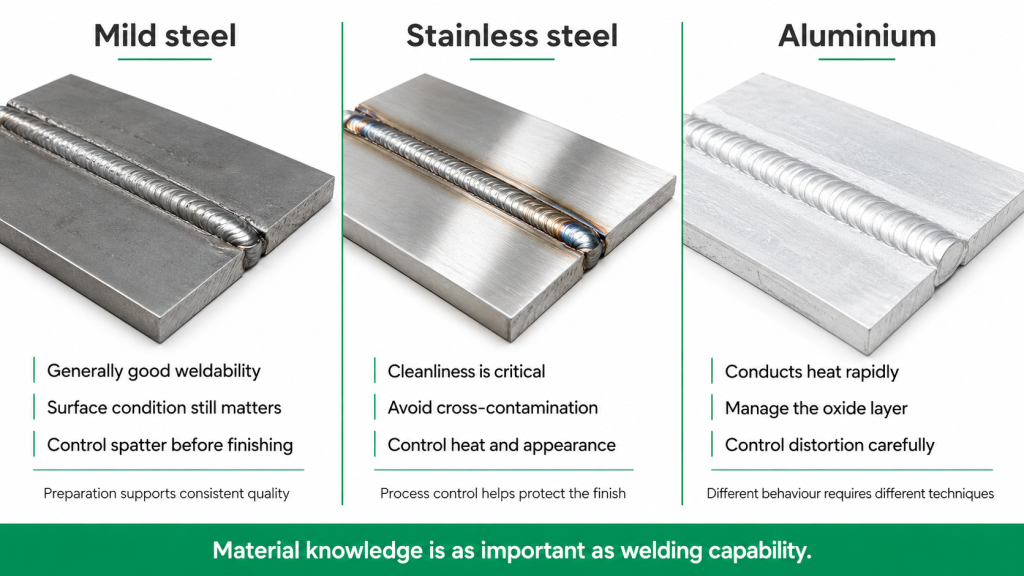
Different materials behave differently during welding, which means material knowledge is just as important as welding capability.
A supplier may be highly experienced in welding mild steel but have considerably less experience working with stainless steel or aluminium. Each material introduces its own manufacturing considerations, affecting weld quality, distortion, preparation and finishing requirements.
Understanding those differences allows better decisions to be made before production begins.
| Material |
Manufacturing Considerations |
| Mild steel |
Generally offers good weldability, but joint preparation, material thickness and surface condition still influence weld quality. Components destined for powder coating also benefit from controlling weld spatter and surface finish. |
| Stainless steel |
Requires greater attention to cleanliness and contamination control. Heat input can affect both appearance and corrosion resistance, making process control particularly important where cosmetic finishes are required. |
| Aluminium |
Conducts heat much more rapidly than steel, requiring different welding techniques and careful distortion management. Oxide layers must also be considered during preparation to achieve consistent weld quality. |
Welding doesn’t exist in isolation. Surface finish, weld profile and spatter control can all influence downstream finishing processes, particularly where metal powder coating forms part of the finished specification. Considering these requirements before production begins can reduce rework and help achieve a more consistent finished appearance.
Material thickness also influences the manufacturing approach.
Thinner sheet materials can distort more easily if excessive heat is introduced during welding. Thicker sections may require different joint preparation or welding parameters to achieve suitable penetration and consistency.
These considerations often affect more than the welding stage alone.
For example, changing material thickness may influence bend radii, component flat patterns, fixture design and finishing processes. Looking at welding within the context of the complete fabrication workflow helps ensure those decisions complement one another rather than creating unnecessary manufacturing challenges.
Design tip
If you’re still finalising a new product, involving your manufacturing partner during the design and prototyping stage can help identify opportunities to simplify fabrication before production drawings are released. Small adjustments to joint design, weld access or component geometry are often far easier to make at this stage than once manufacturing begins.
Small adjustments to joint design, access for welding or component geometry can sometimes improve manufacturability without changing the product’s intended function.
Those conversations are usually far easier before production begins than after tooling, drawings or purchasing decisions have already been finalised.
Assess Their Lead Times and Delivery Performance
Reliable delivery is just as important as weld quality because even well-manufactured components lose their value if they arrive too late to support production.
When comparing suppliers, it’s tempting to focus on quoted lead times alone. However, a realistic delivery commitment backed by effective production planning is often far more valuable than an ambitious promise that proves difficult to maintain.
A dependable manufacturing partner should be able to explain how work is scheduled, how customer priorities are managed and how they communicate if project requirements change.
Rather than asking, “What’s your lead time?”, consider asking:
- How do you schedule production across multiple manufacturing processes?
- How are engineering changes managed once production has been planned?
- How do you communicate if material availability or customer requirements change?
- Can repeat orders be planned in advance to support ongoing production?
- Who will be your day-to-day point of contact throughout the project?
These conversations provide a clearer picture of how a supplier operates than a lead time quoted in isolation.
For welded fabrications, production often depends on several interconnected processes. Components may need to be laser cut, folded, machined or fitted with inserts before welding can begin. Following welding, assemblies may require finishing, inspection or final assembly before dispatch.
Any delay at one stage can affect the entire manufacturing programme.
At Greengate, projects are approached as complete manufacturing programmes rather than disconnected operations. Considering each production stage together encourages realistic planning and helps ensure customers remain informed as projects progress.
A question worth asking
Ask how the supplier manages unexpected design revisions during production.
Manufacturing changes are common, particularly during new product introduction. Understanding how those changes are assessed and communicated can tell you a great deal about how organised the supplier’s manufacturing process is.
Review Their Certifications and Industry Standards
Relevant certifications can provide additional confidence, but they should support proven manufacturing capability rather than replace it.
Many procurement processes include certification as part of supplier approval, particularly in sectors with stricter quality or regulatory requirements. While recognised management systems demonstrate that documented processes are in place, they do not automatically guarantee the quality of individual welded components.
The strongest suppliers combine structured quality management with practical manufacturing expertise.
When discussing certifications or quality systems, consider asking about:
- Quality management procedures
- Process documentation
- Traceability requirements where applicable
- Inspection records
- How customer specifications are controlled throughout production
It is equally important to understand whether those processes are appropriate for your project.
A straightforward sheet metal bracket and a complex fabricated assembly destined for a regulated industry may require very different levels of documentation and quality control. Good suppliers recognise these differences and tailor their manufacturing approach accordingly.
Rather than viewing certifications as a tick-box exercise, use them as one part of a wider assessment that also considers engineering knowledge, manufacturing experience and production consistency.
Don’t overlook practical evidence
A supplier’s ability to explain how they manufacture your components is often just as valuable as the certificates displayed on the wall.
Confident manufacturers should be comfortable discussing production methods, fabrication challenges and the practical decisions that influence finished quality.
Request Samples or Examples of Previous Work
Previous work provides valuable evidence of a supplier’s capabilities because it demonstrates how manufacturing expertise has been applied in practice.
That doesn’t necessarily mean asking to see projects identical to your own. In many industries, customer confidentiality prevents manufacturers from sharing detailed project information.
Instead, look for evidence of comparable manufacturing capability.
Useful questions include:
- Have they produced assemblies with similar levels of complexity?
- Can they discuss comparable fabrication challenges?
- Have they worked with similar materials?
- Can they explain how manufacturing issues were addressed?
- Are they able to demonstrate consistency across repeat production?
The quality of the conversation is often just as revealing as the examples themselves.
Experienced fabrication specialists are usually able to explain why certain manufacturing decisions were made, what production considerations influenced the process and how fabrication, welding and finishing work together to produce the final assembly.
That depth of understanding is difficult to fake.
Common procurement mistake
Selecting a supplier solely because they have manufactured products within your industry.
Industry experience is valuable, but manufacturing complexity is often a more meaningful comparison.
A supplier that regularly produces intricate welded enclosures, machine frames or fabricated assemblies may be better suited to your requirements than one whose sector experience appears relevant on paper but whose production work is significantly less demanding.
Ultimately, you’re looking for evidence that the supplier understands the engineering principles behind your project rather than simply recognising the industry it belongs to.
Choosing the right MIG welding supplier isn’t about finding the business with the longest equipment list or the lowest quotation. It’s about selecting a manufacturing partner that understands how every stage of production contributes to the finished component.
From material selection and fabrication through to welding, inspection and delivery, each decision has the potential to influence quality, repeatability and long-term manufacturing performance. Looking beyond headline claims and asking practical questions about production processes will give you a far clearer understanding of whether a supplier is the right fit for your project.
Greengate Metal Components believes the strongest manufacturing partnerships begin with open technical conversations. Discussing drawings, production requirements and potential manufacturing challenges early in the process often helps identify opportunities to improve manufacturability before work reaches the shop floor.
If you’re planning a welded fabrication project, whether it’s a prototype, a repeat production batch or part of a larger manufacturing programme, contact us to discuss your requirements and explore the most practical manufacturing approach for your components.


