Two welded assemblies can look almost identical from the outside, yet perform very differently in service. The difference often lies beneath the surface.
Weld penetration plays an important role in creating a sound welded joint, but it is only one part of a much wider manufacturing process. The strength and consistency of a fabricated assembly depend on several interacting variables, including joint preparation, heat input, material thickness and the way welding procedures are controlled throughout production.
For manufacturers, design engineers and procurement teams, understanding these factors isn’t about learning how to weld. It’s about recognising why apparently similar fabrication suppliers can produce very different manufacturing outcomes.
One of the most common misconceptions is that more weld penetration automatically creates a stronger joint. In reality, the objective is rarely to maximise penetration. The goal is achieving the appropriate penetration for the application while maintaining consistency across every component produced.
That distinction becomes particularly important during repeat production. A single acceptable weld demonstrates capability. Producing hundreds of welded assemblies with the same quality, dimensional accuracy and repeatability demonstrates manufacturing control.
At Greengate Metal Components, MIG welding forms one stage within a wider fabrication process, where material preparation, laser cutting, forming, finishing and inspection all contribute to the quality of the finished assembly, which is why consistent production depends on controlling the complete manufacturing process rather than focusing on a single welding variable.
This guide explores five of the most significant factors influencing MIG weld penetration, while explaining why they matter for anyone designing, specifying or sourcing welded fabrications.
1. Welding Current and Amperage Settings
Higher welding current generally increases weld penetration, but only when it is balanced with the other variables that influence heat input and joint quality.
Current is often one of the first settings discussed when talking about weld penetration because it directly affects the amount of heat delivered into the joint. Increase the current and, in many situations, penetration also increases.
However, manufacturing is rarely that straightforward.
Simply increasing amperage without considering material thickness, travel speed, joint design or wire feed can introduce new problems. Excessive heat may increase distortion, raise the risk of burn-through on thinner materials or create unnecessary rework during fabrication.
The objective isn’t maximum heat. It’s controlled heat.
For production welding, achieving consistent penetration repeatedly is usually far more valuable than producing the deepest possible weld on a single component.
Why this matters in production
Imagine two batches of fabricated brackets.
The first batch is welded using carefully controlled procedures that match the material thickness and joint design. The second relies on individual operator judgement, with welding parameters varying slightly throughout production.
Both batches may initially appear acceptable.
As production continues, however, inconsistencies in heat input begin affecting weld appearance, dimensional stability and repeatability. Those differences can become increasingly noticeable once components move into assembly, coating or final inspection.
This is why experienced manufacturers document welding procedures and use consistent process controls rather than relying solely on individual operator preference.
Manufacturing Insight
The best production welding isn’t necessarily the hottest; it’s the most repeatable.
Every welded assembly should receive the appropriate amount of heat required for that joint, every time.
Manufacturers often benefit from choosing a supplier whose metal welding capability forms part of a wider fabrication process. Controlling component preparation, forming and welding together helps reduce unnecessary variation before fabrication reaches the inspection stage.
Common Assumption
“More amperage means a stronger weld.”
Not necessarily.
Appropriate current depends on the material, joint configuration and application. Excessive heat can introduce distortion or create defects that are just as undesirable as insufficient penetration.
2. Wire Feed Speed Selection
Wire feed speed directly influences deposition rate and, on many MIG welding systems, has a close relationship with welding current, making it another important factor in achieving consistent weld penetration.
It is easy to think of wire feed as simply controlling how much filler material enters the joint.
In reality, changing wire feed speed also alters the behaviour of the welding arc. If the wire feed and current are poorly balanced, the arc may become unstable, affecting penetration, bead profile and overall weld consistency.
For manufacturers producing repeat batches, maintaining this balance is critical.
A component welded today should be manufactured to the same process as one produced several months later. Consistent welding parameters help make that possible.
Why this matters in production
Consider a production run involving several hundred fabricated enclosures.
If wire feed speed varies throughout manufacture, weld appearance may begin changing from one component to the next. More importantly, the heat introduced into each joint may also vary, influencing penetration, distortion and overall consistency across the production batch.
Those differences may not always be visible immediately.
They can, however, affect downstream manufacturing processes, particularly where multiple fabricated parts must fit together accurately during assembly.
Manufacturing Insight
Process control becomes increasingly valuable as production volumes increase.
Prototype work often allows more opportunity for adjustment.
Repeat production depends on removing unnecessary variation wherever possible.
That philosophy extends well beyond welding, because accurate sheet metal fabrication creates better joint fit-up before welding begins, reducing the need for operators to compensate for inconsistencies later in the manufacturing process.
3. Travel Speed During Welding
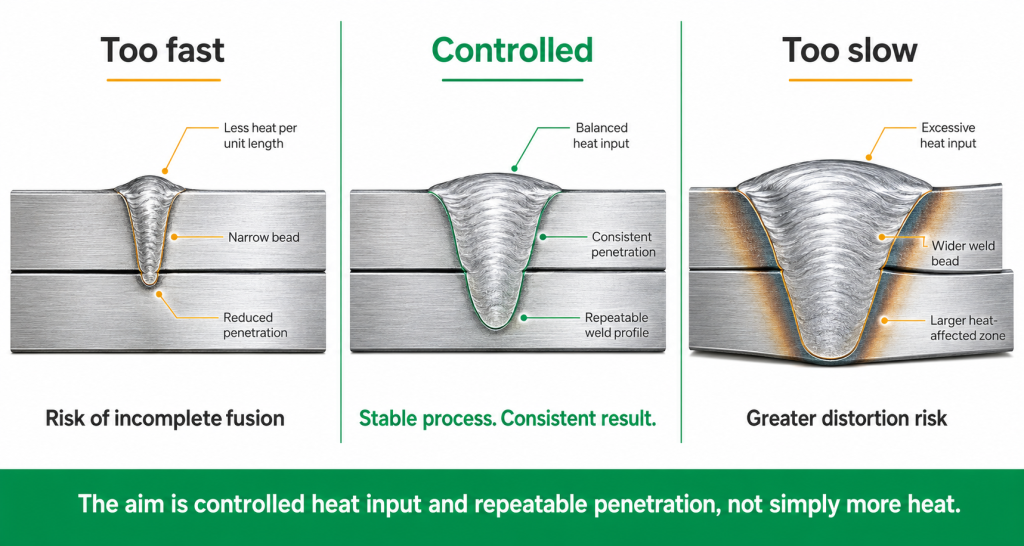
Travelling too quickly can reduce weld penetration, while travelling too slowly can introduce excessive heat, increase distortion and affect overall manufacturing consistency.
Travel speed is one of the clearest examples of why weld penetration should never be considered in isolation.
A faster travel speed reduces the amount of time heat is applied to the joint. Depending on the material and application, this may result in shallower penetration or incomplete fusion. Conversely, moving too slowly increases heat input, which can alter the weld profile, enlarge the heat-affected zone and increase the likelihood of distortion.
Finding the right balance is therefore essential.
The objective is not simply to achieve adequate penetration, but to do so while maintaining dimensional stability and repeatability throughout production.
Comparing the Effect of Travel Speed
| Travel Speed |
Typical Manufacturing Considerations |
| Too fast |
Reduced penetration, narrower weld bead and an increased risk that the joint may not achieve the intended weld profile. |
| Controlled |
Balanced heat input, consistent penetration and repeatable weld quality suited to the application. |
| Too slow |
Greater heat input, increased distortion, larger heat affected zones and longer production times. |
Why this matters in production
Imagine a series of long welded seams on fabricated equipment housings.
If travel speed varies between operators or across different production batches, heat input also changes. One assembly may remain dimensionally stable, while another requires additional straightening before progressing to the next manufacturing stage.
Although the welding itself may appear acceptable, unnecessary distortion introduces extra handling, inspection and, potentially, rework.
Those additional production steps consume time without adding value.
Distortion and excessive weld build-up can also affect downstream finishing, particularly where fabricated assemblies require powder coating and a consistent surface appearance.
At Greengate, welding procedures are viewed within the wider manufacturing process. Maintaining consistent travel speed is just one part of controlling the variables that influence fabrication quality from the first component to the last.
Manufacturing Insight
One well-produced weld tells you very little about a manufacturer’s overall capability.
Consistently producing the same weld hundreds of times, while maintaining dimensional accuracy and production efficiency, demonstrates that the underlying manufacturing process is under control.
4. Joint Preparation and Fit-Up Quality
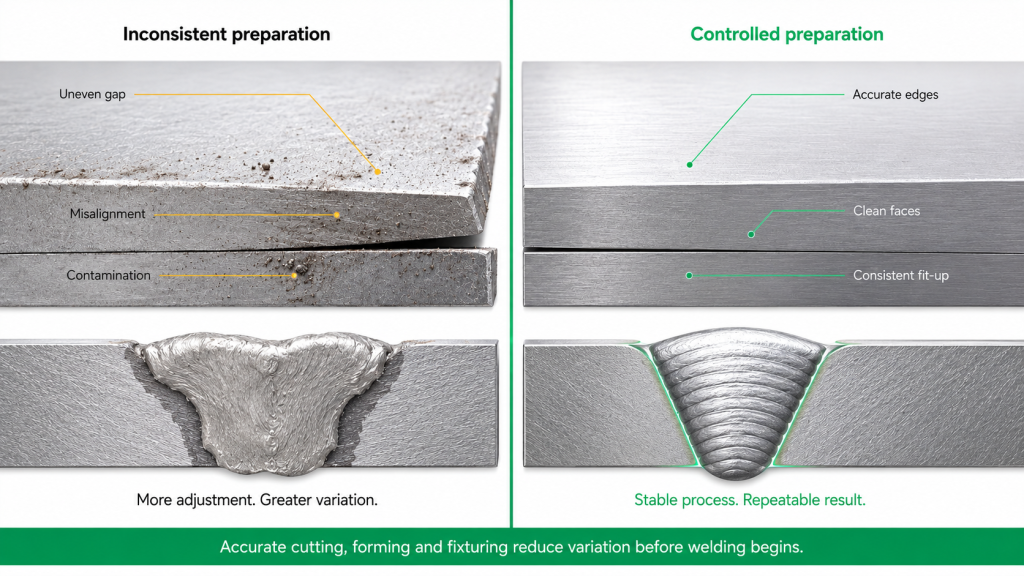
Even correctly adjusted welding equipment cannot compensate for poor joint preparation.
Joint preparation is one of the most overlooked factors affecting weld penetration, yet it often determines how straightforward a welded assembly will be to manufacture.
Before welding begins, components must fit together as intended.
Components produced through accurate CNC metal laser cutting are more likely to achieve consistent joint fit-up, helping reduce gaps, unnecessary adjustment and variation before welding starts.
Consistent metal bending and forming also affects weld preparation, especially where folded components need to align accurately before being fixtured and joined.
Gaps that are larger than expected, inconsistent edge quality, contamination or poorly prepared joint faces all influence how the weld behaves. Operators may need to adjust travel speed, increase heat input or add additional filler material simply to compensate for problems that originated much earlier in the manufacturing process.
Good welding begins with good preparation. This is why experienced fabrication companies focus on the complete production sequence rather than treating welding as a standalone operation.
Why this matters in production
Consider a batch of laser-cut brackets that will later be welded into a structural assembly.
If the cut components vary slightly in profile or are not prepared consistently before welding, each joint may require small adjustments during assembly. Individually these differences appear insignificant.
Across an entire production batch, however, they introduce unnecessary variation that affects welding consistency, production time and ultimately the finished quality of the assembly.
By comparison, accurately prepared components with consistent fit-up allow welding procedures to remain stable from one assembly to the next.
Good joint preparation typically includes
- Accurate component dimensions before welding
- Appropriate edge preparation where required
- Clean joint surfaces free from contamination
- Consistent fit-up between mating components
- Suitable joint design for the intended application
The quality of these earlier manufacturing stages has a direct influence on the welding process itself.
Manufacturers often benefit from working with a supplier capable of managing both sheet metal fabrication and welding within the same production workflow. Producing components under one coordinated manufacturing process improves communication between production stages and helps maintain consistent joint fit-up before welding begins.
Common Assumption
“The welder will make it fit.”
Experienced welders can accommodate small variations, but they shouldn’t be expected to compensate for inconsistent fabrication.
The more predictable the component preparation, the more repeatable the welding process becomes.
That repeatability is one of the foundations of reliable manufacturing.
5. Shielding Gas Composition
Different shielding gas mixtures influence arc characteristics, weld penetration and overall weld behaviour, making gas selection another important part of achieving consistent production quality.
Shielding gas protects the molten weld pool from atmospheric contamination, but it also affects how the welding arc behaves.
Different gas mixtures can influence factors such as:
- Arc stability
- Penetration profile
- Weld bead appearance
- Heat distribution
- Spatter levels
The most appropriate choice depends on the material being welded, joint design and the requirements of the finished component.
Like every other variable discussed throughout this guide, shielding gas should not be viewed in isolation.
It forms part of an overall welding procedure designed to deliver consistent manufacturing outcomes.
General Characteristics of Common Shielding Gases
| Shielding Gas |
Typical Manufacturing Considerations |
| Argon-rich mixtures |
Often provide a stable arc and good weld appearance for many fabrication applications. |
| Carbon dioxide (CO₂) |
Can provide deeper penetration characteristics in some applications but may also produce increased spatter compared with mixed gases. |
| Mixed shielding gases |
Frequently selected to balance penetration, arc stability and overall weld quality depending on the application. |
The appropriate gas mixture should always reflect the material, welding procedure and intended service conditions rather than a one-size-fits-all approach.
Why this matters in production
Changing shielding gas doesn’t simply alter the appearance of a weld.
It can influence the consistency of the entire manufacturing process.
When welding procedures are developed and then followed consistently across repeat production, manufacturers are better placed to achieve predictable weld quality from one component to the next.
That consistency becomes particularly valuable where fabricated assemblies contain numerous welded joints, each contributing to the performance of the finished product.
Question Worth Asking Your Fabricator
Rather than asking what shielding gas is used, ask how welding procedures are controlled across repeat production.
The answer will often reveal far more about the manufacturer’s process than any individual welding parameter.
Experienced fabrication partners understand that weld quality comes from controlling every stage of manufacture, from material preparation and component accuracy through to welding, inspection and finishing.
MIG weld penetration is influenced by far more than a single machine setting.
Welding current, wire feed speed, travel speed, joint preparation and shielding gas all interact throughout the manufacturing process. Focusing on one variable while overlooking the others rarely produces consistent results.
More importantly, maximum penetration is not the objective.
The goal is achieving the appropriate penetration for the application while maintaining repeatability, dimensional accuracy and efficient production.
That distinction is particularly important for manufacturers outsourcing welded fabrications. A supplier’s ability to control welding procedures consistently often has a greater impact on finished quality than the specification of any individual welding machine.
At Greengate Metal Components, welding is approached as one stage within a complete manufacturing process. Material preparation, fabrication, welding and finishing are considered together because every stage influences the next. Looking at projects holistically helps reduce unnecessary variation while supporting reliable, repeatable production.
If you’re planning a fabricated component or welded assembly, contact us to discuss your drawings, material requirements and manufacturing objectives before production begins. Early engineering discussions often identify practical opportunities to improve manufacturability while ensuring the welding process supports the finished performance of the component rather than simply completing the joint.


