High-strength sheet metals have become increasingly common across modern manufacturing. Their ability to deliver excellent structural performance while helping reduce component weight makes them an attractive choice for industries ranging from transport and construction equipment to renewable energy, defence and industrial machinery.
However, selecting a higher-strength material isn’t simply a material specification decision. It also changes how a component behaves throughout manufacture.
Compared with conventional mild steels, high-strength sheet metals often demand greater forming forces, tighter process control and more careful consideration during fabrication. Decisions that appear straightforward on a CAD model can become significantly more challenging once material reaches the shop floor.
For design engineers, product developers and procurement teams, understanding these manufacturing implications early can help avoid unnecessary production costs, reduce delays and improve the overall manufacturability of a component.
At Greengate Metal Components, discussions around material selection often extend beyond strength alone. The most successful projects balance performance with practical manufacture, ensuring components achieve their design objectives without introducing avoidable complexity later in production.
This guide explores seven common challenges associated with high-strength sheet metals and explains why considering fabrication from the earliest stages of design can lead to better manufacturing outcomes.
1. Increased Springback During Forming Operations
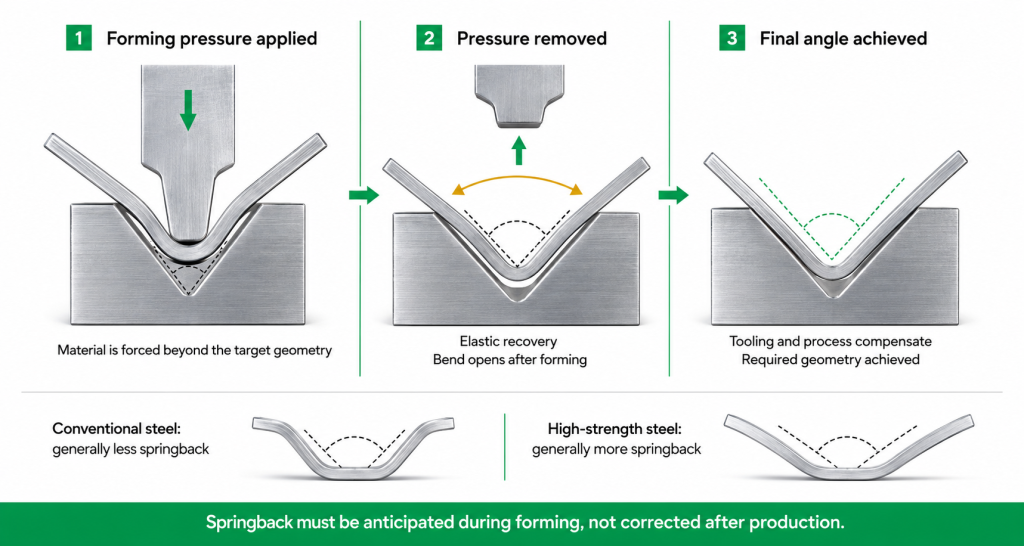
Higher-strength materials resist permanent deformation more than conventional steels, making springback one of the most significant challenges during bending operations.
Springback occurs when material attempts to return towards its original shape after forming pressure is removed. While every sheet metal behaves this way to some degree, the effect generally becomes more pronounced as material strength increases.
For manufacturers, this means achieving a precise bend angle is rarely as simple as programming the required angle into a press brake.
Instead, experienced operators compensate for springback by adjusting tooling, bend angles and forming processes until the required geometry is achieved consistently. Effective metal bending and forming relies on understanding how different materials behave under load rather than applying identical settings to every component.
Why this matters in production
Imagine a batch of folded support brackets designed to assemble into a larger fabricated frame.
If each bracket springs back by even a small amount beyond the intended angle, those individual variations can accumulate throughout the assembly. Components may require adjustment during fitting, fixing points can become misaligned and downstream welding or assembly operations become more difficult than originally planned.
This is one reason why springback should always be considered during design rather than corrected after production has begun.
Designers can help minimise these issues by considering:
- Appropriate bend radii
- Material grade during specification
- Consistent bend geometry
- Manufacturing tolerances that reflect realistic forming behaviour
At Greengate, springback is considered alongside the complete forming process rather than treated as a problem to solve after bending. Discussing these considerations early helps identify practical manufacturing solutions before production begins.
Design Tip
Where possible, involving your manufacturing partner during the design and prototyping stage often makes it easier to identify opportunities to simplify fabrication before production drawings are released.
2. Greater Tool Wear and Maintenance Requirements
High-strength materials place greater demands on forming tools, meaning tooling condition becomes increasingly important for maintaining consistent production quality.
Compared with lower-strength materials, higher-strength steels generally require greater forming forces. Over repeated production runs, these increased loads can contribute to higher levels of tooling wear.
This isn’t simply a maintenance issue.
Tool condition influences the consistency of every component leaving the press brake.
As tooling wears over time, manufacturers may begin to see subtle changes in:
- Bend consistency
- Surface marking
- Dimensional repeatability
- Overall forming accuracy
While quality tooling is designed to withstand demanding production environments, maintaining that tooling becomes an important part of delivering consistent results across repeat manufacturing programmes.
Why this matters in production
When components are produced as part of larger welded assemblies, even relatively small dimensional variations can affect fit-up further down the production process.
A component that forms slightly differently because of worn tooling may still appear acceptable in isolation. Once assembled alongside dozens of other fabricated parts, however, those small differences can begin affecting alignment, welding and final assembly.
This is another reason experienced manufacturers place as much emphasis on process control as they do on equipment investment.
Good manufacturing isn’t simply about having capable machinery. It’s about ensuring every stage of production continues delivering repeatable results over time.
3. Reduced Formability Compared to Conventional Steels
High-strength sheet metals generally offer lower formability than conventional steels, making complex bends, tight radii and intricate geometries more challenging to manufacture consistently.
That doesn’t mean these materials should be avoided. Far from it. High-strength steels can deliver significant performance benefits when they’re specified for the right application. The key is recognising that increased strength often comes with reduced ductility, requiring designs to better accommodate the way the material behaves during forming.
For engineers, this is where Design for Manufacture (DFM) becomes particularly valuable.
A component that looks straightforward in a CAD model may require multiple forming operations, specialised tooling or revised bend geometry to produce reliably from a higher-strength material. Without considering those factors during design, production can become unnecessarily complex, increasing both manufacturing time and the risk of inconsistencies.
Why this matters in production
Imagine a fabricated enclosure containing several closely spaced bends, return flanges and cut-outs.
In conventional mild steel, that geometry may form without issue. Produce the same component in a high-strength material, and those features may begin interacting differently during forming. Tight bends can become more demanding, flange distortion may increase and maintaining dimensional accuracy across multiple bends becomes more difficult.
None of these challenges are insurmountable, but they do require careful planning.
This is why material selection and component geometry should always be considered together rather than as separate design decisions.
Comparing High-Strength and Conventional Steels
| Consideration |
Conventional Mild Steel |
High-Strength Sheet Metal |
| Formability |
Generally more forgiving |
Typically reduced, depending on grade |
| Bend Radius |
Can often accommodate tighter bends |
May require larger bend radii |
| Complex Geometry |
Easier to manufacture |
May require design refinement |
| Springback |
Lower |
Typically more pronounced |
| Manufacturing Planning |
More flexible |
Greater emphasis on DFM and process control |
Common Design Mistake
Specifying the highest-strength material available simply because it appears to offer the greatest performance.
In reality, the optimum material is often the one that delivers sufficient mechanical performance while remaining practical and economical to manufacture.
Increasing material strength without considering manufacturability can introduce unnecessary complexity without providing meaningful benefits for the finished product.
At Greengate, discussions around material selection always consider how a component will actually be manufactured. Looking at bend geometry, fabrication sequence and production requirements together often identifies opportunities to simplify manufacture before production begins.
4. Higher Press Brake Tonnage Requirements
Stronger materials require greater forming force, meaning not every fabrication supplier will have equipment suited to every high-strength application.
As material strength and thickness increase, so too does the force required to bend it accurately. This directly influences machine selection, tooling choice and production planning.
While this may seem like a consideration for the manufacturer rather than the customer, it can have a significant impact on supplier selection.
A fabrication partner should have equipment capable of producing your components consistently, not simply achieving the bend once.
When discussing a project involving high-strength materials, it is worth considering:
- Material grade and thickness
- Bend length
- Number of forming operations
- Production volumes
- Overall component size
- Repeatability requirements
These factors all influence how a component is manufactured.
Why this matters in production
Suppose a product begins as a prototype before progressing into repeat production.
If the manufacturing process is already operating close to equipment limitations, maintaining consistency across larger production batches can become increasingly difficult. Selecting a supplier with suitable forming capability from the outset helps reduce that risk.
This also highlights why early conversations with a fabrication partner are valuable.
Changing a material grade or adjusting a bend radius during design is usually straightforward.
Making those changes after production tooling has been established is considerably more disruptive.
Question Worth Asking Your Fabricator
Rather than asking whether a supplier can bend a particular material, ask how they approach manufacturing it repeatedly.
Consistent production depends on much more than available tonnage. Tooling selection, machine setup, operator experience and inspection all contribute to achieving repeatable results.
For many projects, choosing an experienced sheet metal fabrication partner early in the design process helps identify these considerations before production begins, reducing the likelihood of costly design revisions later.
5. Challenges Maintaining Tight Tolerances
Maintaining tight tolerances becomes more demanding as material strength increases because material behaviour during forming is inherently less predictable than with more ductile steels.
Precision sheet metal fabrication is built on consistency.
Every cutting, forming and welding operation introduces some degree of variation. High-strength materials don’t prevent precision manufacturing, but they often reduce the margin for error, making process control increasingly important.
Several factors contribute to this challenge, including:
- Increased springback
- Variations between material batches
- Forming sequence
- Tooling condition
- Component geometry
- Heat introduced during downstream welding
Each factor may appear relatively minor on its own. Combined across multiple manufacturing stages, however, they can begin influencing the dimensional accuracy of the finished assembly.
Why this matters in production
Imagine manufacturing a series of precision cabinets where doors, internal brackets and removable access panels all rely on accurate alignment.
A small variation introduced during forming may not become apparent until final assembly, when clearances between components are checked.
By that stage, correcting the issue can involve considerably more work than identifying it earlier in production.
That is why experienced manufacturers focus on controlling the entire fabrication process rather than simply inspecting completed components.
Tolerances should be realistic
One of the most common misconceptions in engineering is that tighter tolerances always produce a better component.
In practice, tolerances should reflect the functional requirements of the finished product.
Specifying unnecessarily tight tolerances can increase manufacturing complexity without delivering any meaningful improvement in product performance.
Good engineering is about designing components that are both fit for purpose and practical to manufacture.
At Greengate, discussions around manufacturability often include tolerance reviews alongside material selection and fabrication methods. Considering these factors together helps ensure production requirements remain realistic while supporting consistent manufacturing quality.
Why This Matters in Production
Successful fabrication isn’t about eliminating every variation.
It’s about understanding where variation matters, controlling it through robust manufacturing processes and ensuring the finished assembly performs exactly as intended.
That philosophy is often the difference between a component that can be manufactured consistently and one that becomes unnecessarily difficult or expensive to produce.
6. Heat-Affected Zone Considerations During Welding
The heat generated during welding can influence the properties of high-strength steels, making weld planning and process control an important part of the overall manufacturing strategy.
Welding doesn’t simply join two components together. It also introduces localised heat into the surrounding material, creating what is known as the heat affected zone (HAZ). Within this area, the material undergoes thermal cycles that may alter its microstructure and mechanical properties, depending on the material grade, welding procedure, and joint design.
For this reason, welding should never be considered in isolation.
The decisions made during design, material selection and fabrication all influence how straightforward a component will be to weld successfully.
Several factors deserve consideration when designing welded components manufactured from high-strength sheet metals:
- Joint design and accessibility
- Material thickness
- Heat input during welding
- Weld sequence
- Component restraint and fixturing
- The intended function of the finished assembly
Each of these contributes to achieving consistent, repeatable weld quality.
Why this matters in production
Consider a fabricated machine guard manufactured from folded high-strength sheet steel.
If weld locations haven’t been considered during the design stage, restricted access may force awkward welding positions or unnecessary handling throughout production. Likewise, an unsuitable welding sequence may introduce distortion that affects subsequent assembly operations or dimensional accuracy.
These aren’t necessarily welding problems. They’re manufacturing planning challenges.
The most successful fabrication projects recognise that welding begins long before the first weld is made.
Accurate component preparation through CNC metal laser cutting, consistent forming and effective fixturing all contribute towards producing welded assemblies that are easier to manufacture and inspect.
Design Tip
Where welded joints are unavoidable, think about how the component will actually be manufactured.
Can the weld be accessed easily? Will the assembly require repositioning? Could a small design adjustment simplify fabrication without affecting performance?
Questions like these often produce better manufacturing outcomes than focusing solely on the weld itself.
At Greengate, metal welding is considered alongside fabrication, forming and finishing as part of a complete production process. Looking at the entire manufacturing sequence helps identify practical improvements before production begins, reducing avoidable complexity later on.
7. Increased Risk of Cracking During Fabrication
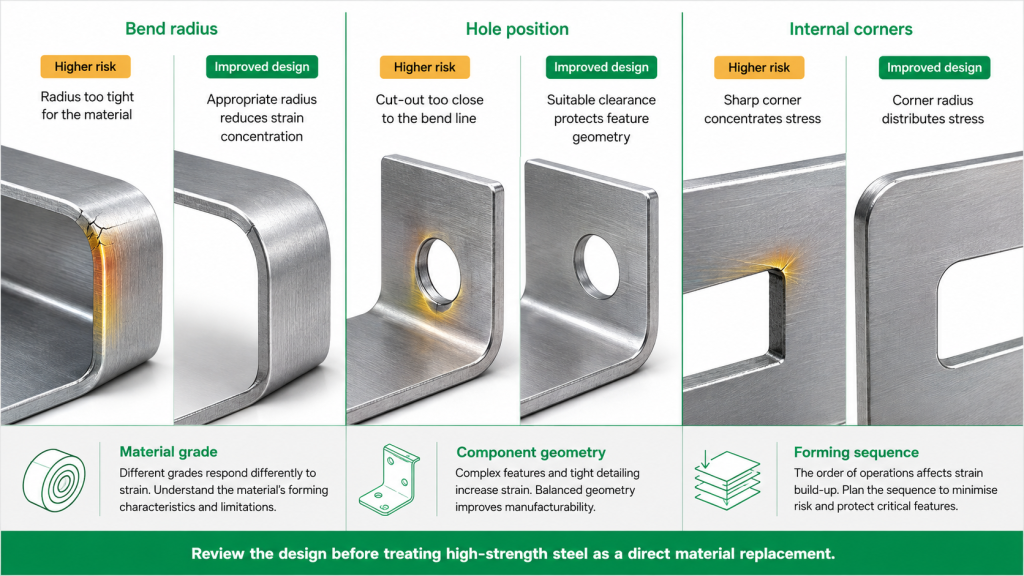
Incorrect processing or unsuitable component design can increase the likelihood of cracking during fabrication, particularly where high-strength materials are combined with demanding geometries or poorly considered manufacturing sequences.
It is important to keep this in perspective.
High-strength sheet metals are successfully fabricated every day across a wide range of industries. The material itself is not inherently problematic. Difficulties are more likely to arise when design decisions fail to consider how those materials behave during manufacture.
Several factors can contribute to increased fabrication risk, including:
- Bend radii that are too tight for the chosen material
- Holes or cut-outs positioned too close to bend lines
- Sharp internal corners that concentrate stress
- Complex forming sequences
- Inappropriate welding procedures
- Limited consideration of material behaviour during design
Viewed individually, these may appear to be relatively small design decisions.
Together, however, they can influence manufacturability, production efficiency and long-term component performance.
Common Design Mistake
Treating high-strength sheet metal as a direct replacement for conventional mild steel without reviewing the design.
Although the finished component may look identical on the drawing, the manufacturing route may need to change considerably. Bend allowances, tooling selection, weld planning and fabrication sequence may all require review before production begins.
Early Design for Manufacture discussions often identify these issues while changes remain straightforward to implement.
Many of these challenges originate from avoidable sheet metal fabrication mistakes made during the design stage rather than problems encountered on the shop floor. Addressing them early usually leads to a more efficient manufacturing process.
Question Worth Asking Your Fabricator
Before releasing drawings for manufacture, ask: “Are there any features in this design that you would recommend changing to improve manufacturability?”
An experienced fabrication partner should be able to identify practical opportunities to simplify production while maintaining the functional requirements of the component.
These conversations are particularly valuable when introducing new products or specifying unfamiliar materials.
They aren’t about changing the engineering intent.
They’re about ensuring the finished design can be manufactured consistently, efficiently and economically.
High-strength sheet metals offer clear engineering advantages, but they also introduce manufacturing considerations that shouldn’t be overlooked.
From increased springback and higher forming forces to welding considerations and tighter process control, every stage of fabrication requires a greater understanding of how the material behaves throughout production.
That doesn’t mean high-strength materials should be avoided. Quite the opposite.
When they’re selected for the right application and supported by thoughtful design, appropriate manufacturing processes and effective production planning, they can deliver excellent results.
The key is recognising that material selection should never happen in isolation.
Design geometry, fabrication methods, tooling, welding, finishing and inspection all influence how successfully a component moves from drawing to finished product. Considering these factors together during the early stages of a project often reduces manufacturing complexity, minimises avoidable revisions and supports more consistent production.
Projects involving multiple fabricated components can also benefit from coordinated sheet metal assembly, reducing unnecessary handling between production stages while improving overall manufacturing efficiency.
At Greengate Metal Components, material selection is considered alongside manufacturability from the outset. By discussing fabrication methods, forming requirements and production considerations before drawings are finalised, it’s often possible to identify practical improvements that simplify manufacture without compromising the design intent.
If you’re considering high-strength sheet metal for an upcoming project, or reviewing an existing design that’s proving difficult to manufacture, contact us to discuss your requirements before production begins. An early conversation can help ensure material selection, fabrication methods and component design work together to support a practical, efficient manufacturing solution.


