Choosing between 304 and 316 stainless steel is rarely a question of which material is “better”. The right choice depends on the operating environment, cleaning regime, exposure to corrosive substances and the expected service life of the finished equipment.
For many food manufacturing applications, 304 stainless steel provides excellent performance at a lower material cost. However, where equipment is exposed to chlorides, aggressive cleaning chemicals or salt-rich environments, investing in 316 stainless steel can reduce maintenance, preserve surface condition and extend the working life of fabricated components.
Making the correct specification before fabrication begins is important. Changing material once drawings have been approved or production is underway can introduce unnecessary cost, delays and redesign work.
Whether you’re designing a new conveyor system, machine enclosure or processing line, understanding how the chosen alloy affects stainless steel fabrication helps avoid unnecessary specification changes later in the project. Greengate supports customers from material selection through manufacture, ensuring designs are practical as well as fit for purpose.
Corrosion Resistance in Food Processing Environments
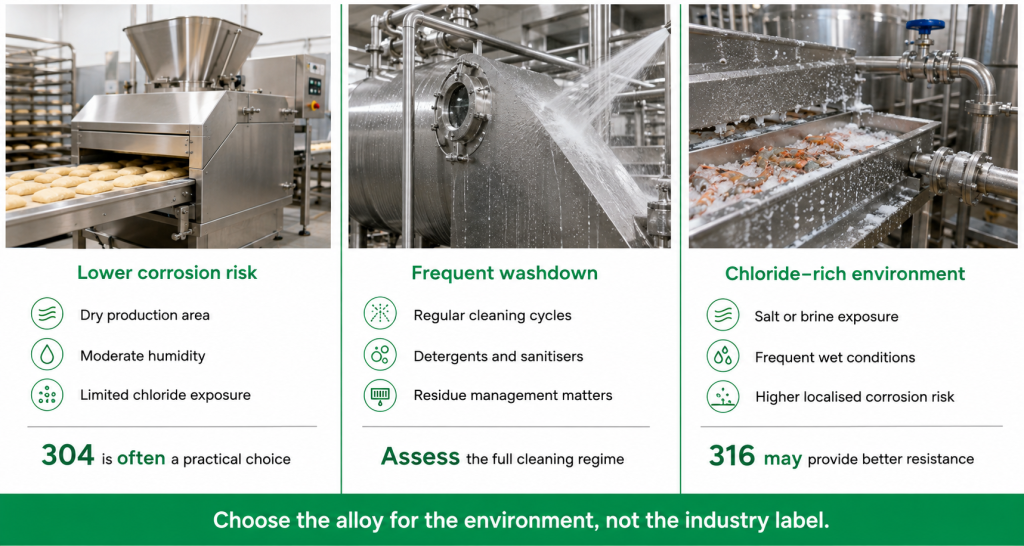
The biggest difference between 304 and 316 stainless steel is corrosion resistance. The addition of molybdenum in 316 improves its resistance to chlorides and other aggressive environments, making it the preferred choice where corrosion risk is higher.
The comparison often becomes oversimplified. It is easy to assume that every food application requires 316, yet many production environments never expose equipment to the conditions that justify the additional cost.
| Consideration |
304 Stainless Steel |
316 Stainless Steel |
| General food production |
Excellent |
Excellent |
| Chloride resistance |
Good |
Very good |
| Salt-rich environments |
Limited |
Better suited |
| Acidic food processing |
Suitable in many applications |
Better resistance in harsher conditions |
| Material cost |
Lower |
Higher |
A bakery manufacturing dry goods presents a very different environment to a seafood processing facility. Flour dust, occasional washdowns and moderate humidity create relatively low corrosion risk, making 304 a practical choice in many cases.
Compare that with fish processing or brining operations. Salt deposits, chloride-rich moisture and frequent washdowns significantly increase the likelihood of localised corrosion. Under these conditions, specifying 316 may help preserve both appearance and long-term performance.
Material selection should therefore be driven by the production environment rather than assumptions about the food industry as a whole.
Resistance to Cleaning Chemicals and Washdown Procedures
Cleaning chemicals often place greater demands on stainless steel than the food products themselves.
Modern food manufacturing relies on rigorous hygiene procedures. Daily washdowns, clean-in-place (CIP) systems, alkaline detergents and acidic sanitisers all interact with fabricated equipment throughout its service life.
The frequency of these cleaning cycles is just as important as the chemicals themselves.
A production line that operates around the clock and undergoes multiple cleaning cycles every day experiences far greater chemical exposure than equipment cleaned once each week. Even relatively mild cleaning agents can accelerate surface deterioration if residues remain on the metal or cleaning procedures are inconsistent.
This is one reason why specification should never focus solely on product contact. Understanding how equipment will be cleaned often provides a more accurate indication of long-term material performance.
Where cleaning regimes are particularly demanding, 316 can provide an additional margin of corrosion resistance. In less aggressive environments, correctly maintained 304 frequently delivers many years of reliable service.
Performance in High Moisture and High Salt Production Areas
Moisture alone rarely dictates material selection, but chloride exposure often does.
A common misconception is that wet environments automatically require 316 stainless steel. In reality, clean water is not usually the determining factor. Problems arise when moisture combines with chlorides, salt deposits or chemical residues that remain on the equipment surface.
Examples include:
- Seafood processing facilities.
- Brining operations.
- Meat processing involving saline solutions.
- Coastal production sites where airborne salt may accumulate.
- Equipment exposed to de-icing salts during transport or storage.
In these situations, corrosion can begin in areas where moisture remains trapped, particularly around welds, fasteners, joints and poorly drained horizontal surfaces.
Good hygienic design becomes just as important as material selection. Eliminating moisture traps, improving drainage and ensuring easy cleaning often reduces corrosion risk more effectively than simply upgrading the alloy.
Mechanical Strength and Durability Under Production Demands
For most fabricated food equipment, both grades offer comparable mechanical performance.
There is little benefit in selecting 316 solely because greater strength is assumed. Both alloys provide excellent formability and are widely used for fabricated enclosures, machine guards, conveyor components, cabinets, workstations and processing equipment.
In practical fabrication, engineers are more likely to evaluate factors such as:
- Component geometry.
- Forming requirements.
- Weld access.
- Surface finish.
- Manufacturing tolerances.
- Expected operating environment.
The mechanical differences between the grades are unlikely to influence these decisions for the majority of food manufacturing applications.
Instead, corrosion resistance and environmental exposure remain the primary drivers behind specification.
Weldability and Fabrication Considerations
Both 304 and 316 fabricate well, although welding procedures, filler materials and post-weld finishing should always suit the chosen application.
From a fabrication perspective, both materials are well suited to CNC laser cutting, CNC punching, folding, forming and welding. Neither grade presents significant challenges when processed using appropriate manufacturing methods.
However, selecting the correct alloy is only part of producing durable food-grade equipment.
The quality of the fabrication process has a direct influence on long-term performance. Excessive heat input, poor weld profiles or inadequate post-weld finishing can reduce corrosion resistance regardless of whether 304 or 316 has been specified.
This is particularly relevant around welded joints.
Poorly finished welds create crevices that retain moisture, cleaning chemicals and food residue. Over time, these areas become more difficult to clean and more susceptible to corrosion than smooth, fully finished surfaces.
For this reason, fabrication quality should always be considered alongside material choice rather than as a separate decision.
After fabrication, the quality of the metal welding process and any subsequent dressing or polishing frequently determines how easy the finished component is to clean over its service life.
Surface Finish and Hygienic Performance
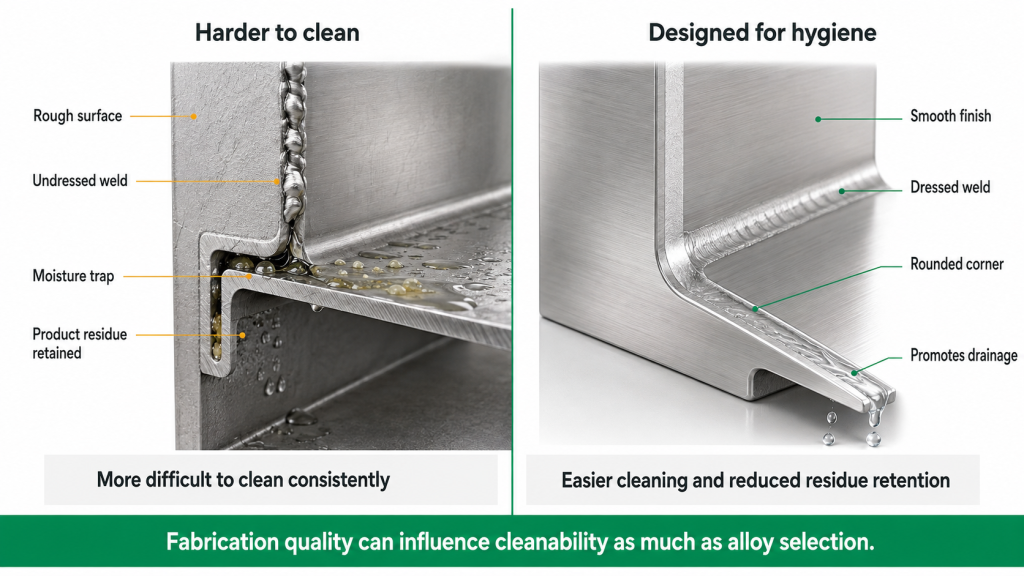
Surface finish often has a greater influence on hygiene than the choice between 304 and 316 stainless steel.
Food manufacturers understandably focus on selecting the correct alloy, but the finish applied to fabricated components frequently has a greater effect on cleanability.
Rough surfaces increase the likelihood of retaining product residue, moisture and cleaning chemicals. They also make routine cleaning more time-consuming and less effective.
A well-executed hygienic finish typically includes:
- Smooth, consistent surface finishes.
- Fully dressed welds where required.
- Minimal crevices.
- Rounded internal corners where practical.
- Fabrication that promotes drainage and easy cleaning.
These considerations support hygienic design regardless of whether the equipment is manufactured from 304 or 316.
In many applications, improving fabrication details delivers greater long-term value than upgrading the material specification alone.
Where components are not intended for direct food contact, secondary finishing processes may also form part of the wider assembly. For example, supporting frames, machine guards or external enclosures may incorporate powder coating to improve durability and appearance, while food-contact surfaces remain bare stainless steel to meet hygienic design requirements.
Compliance with Food Industry Standards and Regulations
Both grades can be suitable for food applications when correctly specified for their intended environment.
There is no universal rule stating that food manufacturing equipment must always be produced from one specific stainless steel grade. Suitability depends on the intended use, operating conditions and applicable industry requirements.
Responsibility for material specification normally rests with the equipment designer, customer or project engineer, taking into account factors such as:
- Food contact requirements.
- Cleaning procedures.
- Production environment.
- Risk assessments.
- Customer specifications.
- Relevant industry standards.
Fabricators can provide practical guidance based on manufacturing experience, but material selection should always reflect the technical requirements of the finished product.
Long-Term Maintenance and Lifecycle Costs
316 typically costs more at the point of purchase, but the lowest material cost is not always the lowest lifetime cost.
When evaluating stainless steel grades, procurement decisions should extend beyond the initial quotation.
| Consideration |
304 |
316 |
| Initial material cost |
Lower |
Higher |
| Performance in mild environments |
Excellent |
Excellent |
| Performance in aggressive environments |
May require increased maintenance |
Better suited |
| Likelihood of premature surface corrosion |
Higher in chloride-rich environments |
Lower |
| Whole-life value |
Strong where corrosion risk is low |
Strong where corrosion risk is high |
For example, specifying 316 for equipment operating in a bakery may provide little practical benefit if corrosion risk is already low.
Conversely, choosing 304 for equipment exposed to daily salt spray or aggressive washdown procedures could lead to more frequent maintenance, earlier refurbishment or premature replacement.
Evaluating the production environment over the expected operating life often results in a more balanced specification decision than comparing material prices alone.
Factors to Consider When Choosing Between 304 and 316 Stainless Steel
The best material is determined by the application, not by selecting the highest specification available.
Before finalising drawings or requesting quotations, it is worth considering the following questions:
- Will equipment be exposed to chlorides or salt?
- How frequently will cleaning take place?
- Which detergents and sanitisers will be used?
- Will the equipment operate in consistently wet conditions?
- Is the production site located in a coastal environment?
- What surface finish is required for hygiene?
- How accessible will components be for maintenance and cleaning?
- What service life is expected?
- Does the additional investment in 316 provide measurable long-term value?
Answering these questions early can prevent unnecessary overspecification while ensuring fabricated components are suited to their operating environment.
If you’re specifying stainless steel components for food-processing equipment and are unsure whether 304 or 316 is the most appropriate choice, Greengate Metal Components can provide practical guidance before manufacturing begins.
Our experience in sheet metal fabrication allows us to consider not only the material itself, but also how fabrication methods, surface finishes and operating conditions influence long-term performance. If you’d like to discuss your application before finalising your drawings, contact us to start the conversation.